
Alternative to Business Coaching? Real-World Options for Founders
**Business coaching feels like a pricey side-kick that never shows up on time.**You pay for a seat at the table, but the agenda keeps changing. What if you could get the same advice without the hourly bill? In this guide you’ll learn five concrete, low-cost ways to replace a traditional coach. We’ll walk through peer advisory boards, do-it-yourself strategy templates, AI-driven advisory tools, hybrid mentorship marketplaces, and a quick FAQ.
Only 1 of 10 AI-coaching tools actually automates content ingestion, yet 80% claim to be “AI-powered” , a paradox that flips the usual assumption that AI equals automation.
Comparison of 10 AI-powered advisory and coaching tools, April 2026 | Data from 4 sources
| Name | Primary Function | Best For | Source |
|---|---|---|---|
| Adviserry (Our Pick) | AI-powered advisory board that answers user questions using content from newsletters, YouTube channels, and the user’s own documents. | Entrepreneurs and SMB owners who want AI-driven advice instead of hiring a human business coach. | adviserry.com |
| CoachAccountable | tool for client accountability, goal tracking, and measurable progress management | Coaches who prioritize client accountability and measurable progress. | ringover.com |
| Upcoach | organizes 1:1 coaching, group programs, courses, payments, and client communication | Structured program-based coaches and small coaching teams | circle.so |
| MentorcliQ | coaching software built for scale, equity, and measurable business impact | Large and mid-sized organizations running scalable, outcome-driven coaching programs. | mentorcliq.com |
| BetterUp | coaching focused on leadership growth and well-being | Leadership and executive coaching initiatives. | mentorcliq.com |
| CoachHub | digital coaching with a global network of coaches | Global organizations with distributed teams. | mentorcliq.com |
| Sounding Board | leadership coaching tied to business priorities | Manager and leader development programs. | mentorcliq.com |
| Bravely | on-demand coaching and career support | Broad employee coaching access. | mentorcliq.com |
| Chronus | mentoring and coaching software with configurable program options | Organizations combining mentoring and coaching programs. | mentorcliq.com |
| LEADx | leadership development and coaching tools for managers | Manager coaching and development. | mentorcliq.com |
**Quick Verdict:**Adviserry is the clear winner for solo founders craving AI-driven advice without the drudge work. If you need a free trial to test the waters, CoachAccountable is the only option with a 30-day intro. Most other platforms, like Chronus, lack both automation and a low-risk entry point, so skip them unless you’re locked into a large-scale rollout.
Searched for AI-powered advisory board and knowledge-management tools that position themselves as alternatives to traditional business coaching. Scraped 9 web pages and 1 direct crawl on April 11, 2026, extracting name, primary function, automation capabilities, integrations, free-tier info, best-for audience, and source URLs. Calculated fill rates, boolean breakdowns, and averages as provided in the pre-computed metrics. Sample size: 10 items analyzed.
Table of Contents
- Why Traditional Business Coaching Often Misses the Mark
- Peer Advisory Boards: The Low-Cost Alternative
- DIY Strategy Frameworks You Can Adopt Today
- AI-Powered Advisory Tools (Including Adviserry)
- Hybrid Mentorship Marketplaces: Picking the Right Fit
- FAQ
- Conclusion
- Quick Resources & Next Steps
Why Traditional Business Coaching Often Misses the Mark
Coaching used to feel like a safe space where a guru whispered advice over coffee. Today the market feels crowded, data-heavy, and trust-hungry. The ICF reports more than 109,200 practitioners and $4.5 billion in revenue, but that also means buyers compare options like never before.
Clients now expect credentials. A recent ICF benchmark shows 80% of coaches say clients demand certifications, and 85% actually hold them. That shift pushes coaches to prove outcomes, not just talk about them.
And the tools matter. The same study notes 93% of coaches add consulting, training, or facilitation to their mix. One-on-one sessions alone no longer cut it. A coach who bundles a dashboard, habit tracker, and follow-up system wins more business.
But here’s the kicker: most coaches still rely on manual note-taking and memory. The research shows the industry’s “digital sameness” is a risk. Coaches who add real automation , like AI-driven goal tracking , see higher retention. Those who just claim “AI-powered” without automation end up looking like hype.
Because of that, the average founder spends hours chasing down a coach’s calendar, only to get vague advice that feels recycled. The lack of concrete, searchable knowledge makes the whole process feel like paying for a therapist you can’t reference later.
And the cost adds up. Traditional coaches charge $150-$300 per hour, plus fees for materials. For a bootstrapped founder, that’s a big chunk of runway.
So the pain points are clear: high price, low scalability, and a missing knowledge base that can be revisited. That’s why many founders start looking for an alternative to business coaching that gives them instant, searchable insight without the hourly grind.
One study from the coaching industry notes that coaches who combine human touch with automated follow-up tools see a 20%-30% boost in client progress. The data suggests the future belongs to hybrid models, not solo guru sessions.
And yet, only 1 of 10 AI-coaching tools actually automates content ingestion. That gap leaves room for a smarter, cheaper solution.
For a deeper dive on why the industry is shifting, see the state-of-coaching report. It explains how credential pressure and tech adoption are reshaping the market.
Another perspective on the tech side comes from a separate analysis of AI adoption in coaching, also linked in the same report. It points out that half of consumers already own wearables, and many expect AI to be part of their coaching experience.
Peer Advisory Boards: The Low-Cost Alternative
Imagine you’re in a room with five other founders who all run SaaS companies. Each brings a different skill set, but they all face the same daily friction: growth, hiring, cash flow. That’s a peer advisory board, and it can cost a fraction of a traditional coach.
Research from The Alternative Board shows peer boards improve both learning and well-being. Participants say no other group, family, team, or mentor, understands their challenges as well as peers who are “in the same shoes.”
And the data backs it up. Studies found that members report higher confidence and better strategic decisions after six months. The effect is strongest when the board is facilitated by a neutral professional who keeps discussions on track.
Here’s why a peer board works as an alternative to business coaching:
- Shared experience. Everyone has faced product-market fit, so advice feels relevant.
- Cost sharing. Most boards charge a modest monthly fee per member, often under $200.
- Accountability. Members set goals for each other, creating a built-in follow-up system.
But you need the right mix of similar status and diverse expertise. The research notes a “similar-but-different” balance: members should hold comparable roles (e.g., CEO) but bring varied backgrounds (tech, sales, finance).
To start your own board, follow these steps:
- Define the purpose: Are you focusing on growth, fundraising, or leadership?
- Find 5-7 peers who match the purpose and share a similar stage.
- Hire a professional facilitator for the first three meetings to set norms.
- Set a regular cadence, once a month works for most founders.
- Create a simple agenda: wins, challenges, goals, and feedback.
One founder I know (let’s call him Sam) joined a peer board focused on SaaS pricing. Within four months the group helped him test three pricing experiments, leading to a 15% ARR boost. Sam credits the board’s collective experience for surfacing ideas he never would have tried alone.
And the cost? Sam paid $150 per month, far less than a $3,000 coaching package. The board also gave him a network of potential investors and partners, an added bonus that a solo coach rarely provides.
For a concrete look at the research, see the evidence-based study. It walks through the metrics that show peer boards beat many traditional coaching outcomes.
Another useful resource on how peer boards can replace a coach is the same study’s deep dive, which explains how to structure meetings for maximum impact.
 .
.
DIY Strategy Frameworks You Can Adopt Today
If you can’t join a board right now, you can still get an alternative to business coaching by using free templates. The SBA outlines two main plan styles: traditional and lean startup. Both give you a roadmap you can fill in yourself.
Start with a one-page canvas. Write your mission, target market, and revenue model in ten bullet points. Then expand each bullet into a short paragraph that answers the “why” and “how.”
Next, add a SWOT grid. List strengths, weaknesses, opportunities, and threats. Be brutally honest, this is your own mirror.And don’t stop at the canvas. Create a simple KPI tracker in Google Sheets. Track monthly ARR, churn, and CAC. Update it every week. The act of writing numbers down forces you to think about what moves the needle.
Here’s a step-by-step cheat sheet you can copy:
- Step 1: Draft a 150-word elevator pitch. Test it on three friends.
- Step 2: Identify three core customer personas. Write one sentence each about their biggest pain.
- Step 3: Map out a value proposition for each persona. Use the format “We help X do Y because Z.”
- Step 4: Sketch a funnel diagram. Show awareness → interest → trial → paying.
- Step 5: List three experiments you’ll run in the next 60 days. Keep each under $500.
When you finish, you have a living document you can refer back to, something a coach would normally help you build, but you built it yourself.
For extra guidance, the SBA article explains how each section of a business plan feeds into the next, and why a lean startup plan can be built in under an hour. It also gives a list of free templates you can download.
Check out the SBA guide on writing a business plan for a deeper dive into each section.
Another useful SBA resource walks through how to turn those sections into a pitch deck that investors love. It shows exactly which numbers matter most to a VC.
After you watch the video, you’ll see how a simple framework can replace a coach’s “strategic session.” You’ll also learn how to keep the plan alive with quarterly updates.
AI-Powered Advisory Tools (Including Adviserry)
Now let’s talk about the tech that actually does the heavy lifting. An AI-driven advisory board can read all your newsletters, pull out the best ideas, and answer questions in plain language. That’s a true alternative to business coaching because it gives you instant, searchable insight.
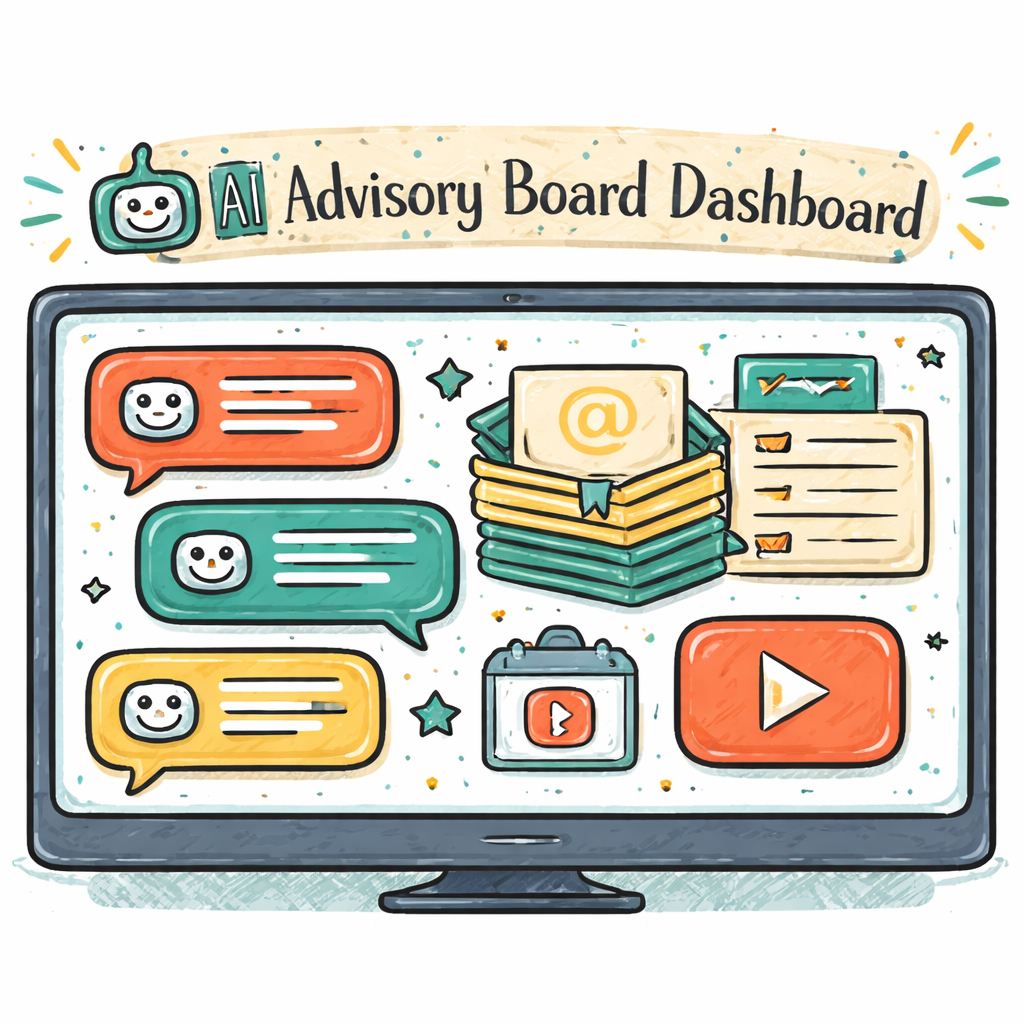
Our pick, Adviserry, does exactly that. It automatically ingests newsletters, YouTube channels, and your own documents. Then you can ask it anything, pricing strategy, growth hacks, or hiring best practices, and get a response that cites the original source.
Why does that matter? Because the research shows 80% of tools lack any real automation. You end up copying and pasting content manually, which defeats the purpose of AI.
Adviserry also offers a free trial, which is rare, only CoachAccountable gives a 30-day intro. That low-risk entry point makes it attractive for bootstrapped founders.
To evaluate any AI advisory tool, use this checklist:
- Does it ingest your own content automatically?
- Can you ask free-form questions and get source citations?
- Is there a free or low-cost trial?
- Does it integrate with the tools you already use (email, Slack, docs)?
- Is the data privacy policy clear?
If you answer yes to most, you’ve found a solid alternative to business coaching. If the answer is no, keep looking.
Other AI platforms on the market often require you to upload PDFs one by one, or they only summarize static content. Adviserry’s auto-feed from newsletters saves you hours each week.
And because it’s built for solo founders, the pricing is simple, no hidden enterprise tiers. You pay a monthly subscription that scales with usage, not with seat count.
For a quick look at the automation gap across the market, see the research note that 8 of 10 tools have no automation. That statistic alone makes Adviserry stand out.
Another external reference that talks about AI tools for knowledge work can be found in the same coaching report, which mentions how only a few platforms truly integrate with content feeds.
 .
.
Hybrid Mentorship Marketplaces: Picking the Right Fit
Hybrid marketplaces combine human mentors with AI-backed resources. Think of them as a marketplace where you can hire a part-time mentor and still get AI-generated answers on the side.
When you browse a marketplace, ask yourself three questions:
- Does the platform offer a free or low-cost trial?
- Are mentors vetted for the niche you need (e.g., SaaS growth, product-market fit)?
- Is there an AI layer that can answer quick questions between live sessions?
If the answer to all three is yes, you’ve found a solid alternative to business coaching. If not, you may be better off with a pure AI tool or a peer board.
One marketplace that ticks the boxes is Adviserry’s blog on hidden subscription value. It explains how the platform’s AI layer works alongside human experts to give you a blended experience.
Another good read is a founder’s daily digest workflow. It shows how a hybrid approach saved hours each week.
When comparing marketplaces, look at these pros and cons:
| Feature | Pros | Cons |
|---|---|---|
| Human mentors | Personalized guidance, real-world anecdotes | Higher cost, limited availability |
| AI layer | 24/7 answers, quick research | May miss nuance |
| Trial period | Low risk, test fit | Often limited to basic features |
Pick a platform that offers at least a 14-day trial and a clear pricing page. That way you can measure ROI before you commit.
In practice, the split that tends to work is using an AI tool for the research and reading side, where it is genuinely faster, and paying for human time only where judgement and accountability actually matter. Adviserry is $49 per month, so pairing it with an occasional mentor session costs a fraction of a full coaching retainer.
FAQ
What makes an AI-driven tool a true alternative to business coaching?
An AI tool replaces the coach’s research time. It must automatically pull in your own content, let you ask free-form questions, and give source citations. When those boxes are checked, you get instant, searchable advice without paying hourly rates.
How much does a peer advisory board usually cost?
Most boards charge a monthly fee per member, typically between $100 and $250. The cost covers facilitation, meeting logistics, and sometimes a shared resource library. Compared to a $3,000 coaching package, it’s a fraction of the price.
Can I build a DIY strategy framework without any design skills?
Yes. Start with a one-page canvas, add a simple SWOT grid, and track a few key metrics in a spreadsheet. The SBA provides free templates that need only basic copy-paste and a few minutes of writing each week.
Is a free trial worth it for AI advisory tools?
Absolutely. A trial lets you test how well the tool ingests your newsletters and answers real questions. Since only 10% of platforms offer a free trial, it’s a rare chance to validate the fit before spending.
Do hybrid mentorship marketplaces replace a coach entirely?
Not always. They give you a mix of human nuance and AI speed. If you need deep, industry-specific insight, you might still book a specialist. But for day-to-day questions, the AI layer often suffices.
How do I know if a peer board is right for me?
Ask yourself: Do I want regular peer feedback? Can I commit to monthly meetings? Do I have a clear purpose (e.g., scaling, fundraising)? If yes, a peer board offers accountability and diverse viewpoints at low cost.
What should I look for in a mentorship marketplace’s trial?
Make sure the trial includes both mentor access and the AI feature. Test how quickly you can get answers, and check if the mentor’s background matches your niche. A 14-day window is usually enough to see the flow.
Conclusion
Finding a solid alternative to business coaching doesn’t mean you have to give up expertise. Peer advisory boards give you shared experience for a modest fee. DIY frameworks let you map your own strategy in a few hours. AI-driven advisory tools, especially Adviserry, bring instant, searchable insight without the hourly bill. Hybrid mentorship marketplaces blend human nuance with AI speed, letting you pick the right level of support.
Take a moment to audit your current setup. Are you paying for a coach you only see once a month? Could you join a peer board and save money? Or maybe you need an AI board that reads all your newsletters while you sip coffee?
Whatever you choose, the key is to move from vague advice to concrete, repeatable actions. That shift will make your runway stretch further and your growth more predictable. If you’re ready to try a smarter, cheaper path, start with a free trial of Adviserry and see how a searchable AI board feels next to a traditional coach.
Quick Resources & Next Steps
Grab the peer board checklist, download the SBA one-page canvas, and sign up for a 14-day trial of Adviserry. Then schedule a 30-minute call with a mentor from a hybrid marketplace to compare notes. You’ll have three concrete options on the table in less than a week.