Your Coach Doesn't Know What Lenny Rachitsky Said Last Week. Your AI Advisor Does.
Your Coach Doesn't Know What Lenny Rachitsky Said Last Week. Your AI Advisor Does.
Last week, Lenny published a breakdown of how the best B2B SaaS companies handle pricing conversations at the enterprise level. It was excellent. Three frameworks I hadn't seen structured that way before. I read it over breakfast and thought about it for the rest of the day.
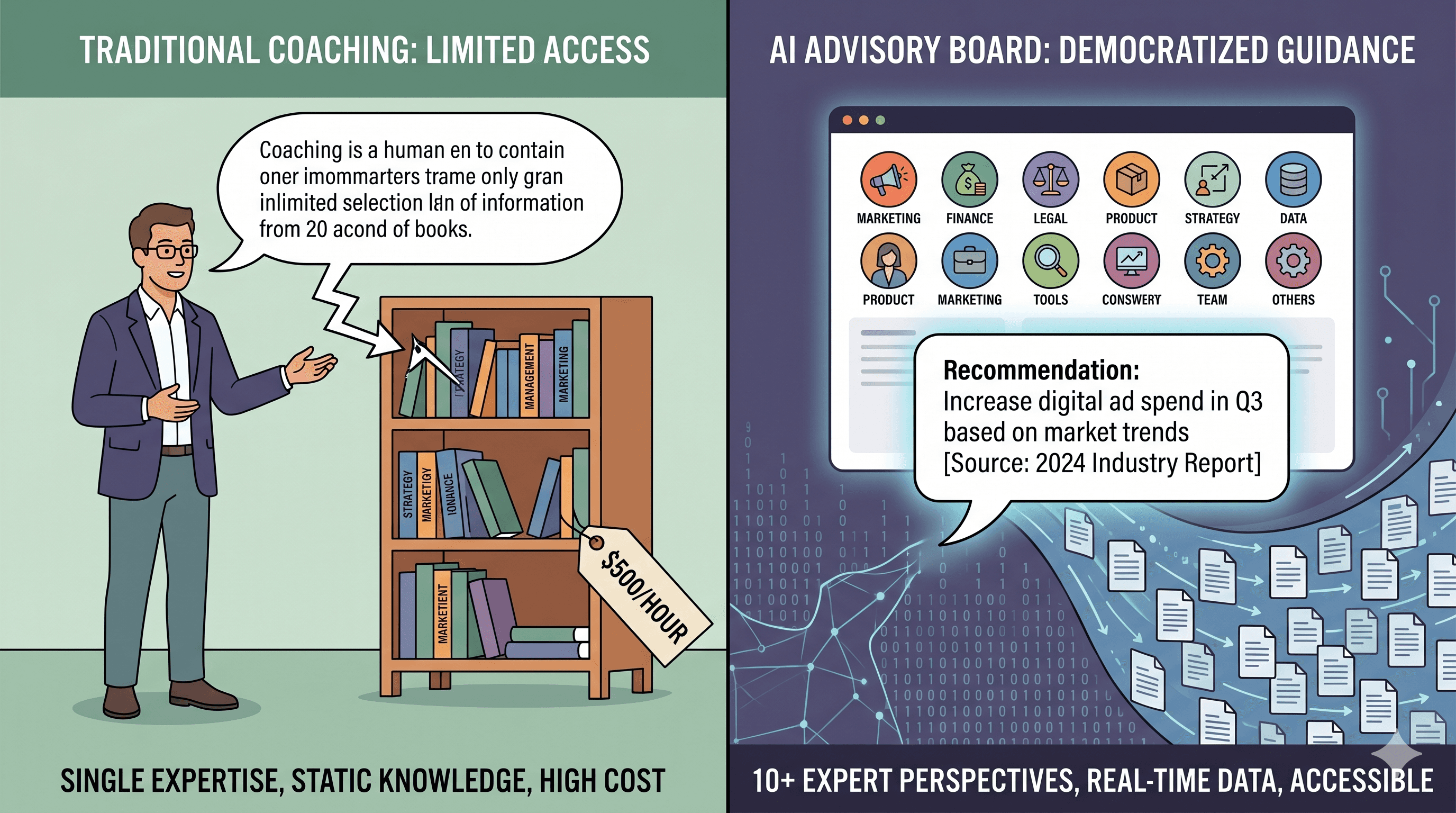
My coach, who is a smart person with real experience, has never read it. He doesn't subscribe. He's not wrong for that; nobody can read everything. But it means that when I ask him about enterprise pricing, he's drawing on his own experience from a company he ran several years ago, in a different market, under different conditions.
That's the breadth problem with human coaches. And it's not a flaw. It's physics.
One person can only know what one person knows.
The best coaches are extraordinarily valuable for exactly the things one person can excel at: knowing you over time, tracking the narrative arc of your business, holding you accountable, noticing the emotional and psychological patterns underneath your tactical questions.
But knowledge breadth? That's not a human strength. Nobody reads everything. Nobody keeps current on every domain. Nobody has deep experience in SaaS pricing and B2B marketing and hiring and fundraising and the specific corner of the market you're operating in.
Your advisory board can.
What a synthesized answer actually looks like.
When I ask my AI advisory board about enterprise pricing conversations, here's what I get: what Lenny's latest research suggests, what the First Round Review has published on discovery call structure, what Hormozi's frameworks imply for anchoring at the enterprise level, and anything relevant from the other sources in my board.
It's not a Wikipedia summary. It's a synthesis of specific expert perspectives, grounded in what they've actually written, filtered through my business context. And it's current, because the sources update regularly and the board indexes new content as it arrives.
My coach can't give me that. Nobody can give me that, except the kind of person who's been collecting and synthesizing expert content across multiple domains for years. Which, it turns out, is exactly what an AI advisory board can do.
The weekly update advantage.
This is the part that doesn't get talked about enough. Expert knowledge compounds. The best operators and investors are constantly updating their thinking: publishing new frameworks, revising their views, reacting to market conditions. A coach who learned their frameworks five years ago doesn't automatically update.
Your AI board does. New content comes in. New context gets indexed. The synthesis stays current.
That's not a knock on coaches. It's a recognition that staying current is a full-time job that a coach doing 10 other client relationships simply can't do for every topic that might matter to you.
Your board should always know what Lenny said last week. That's not a luxury. It's table stakes.
Keep Reading:
- How I Improved My Product Management Skills Using Lenny's Newsletter + Adviserry: a deep dive into using Lenny's content
- How to Cross-Reference Advice From Multiple Experts: synthesizing multiple expert perspectives
- Why You Forget 90% of What You Read: the science behind the recall problem