Adviserry vs. Notion AI vs. Obsidian: Which Knowledge Tool Is Right for You?
Adviserry vs. Notion AI vs. Obsidian: Which Knowledge Tool Is Right for You?
I've used all three. I built one of them. I'm going to try to be honest about all of them.
These tools get compared a lot, but they're actually solving different problems. Picking between them isn't about which is "best." It's about which matches how you actually work. And I mean how you actually work, not how you aspire to work. That distinction matters more than any feature comparison.
The one-line version:
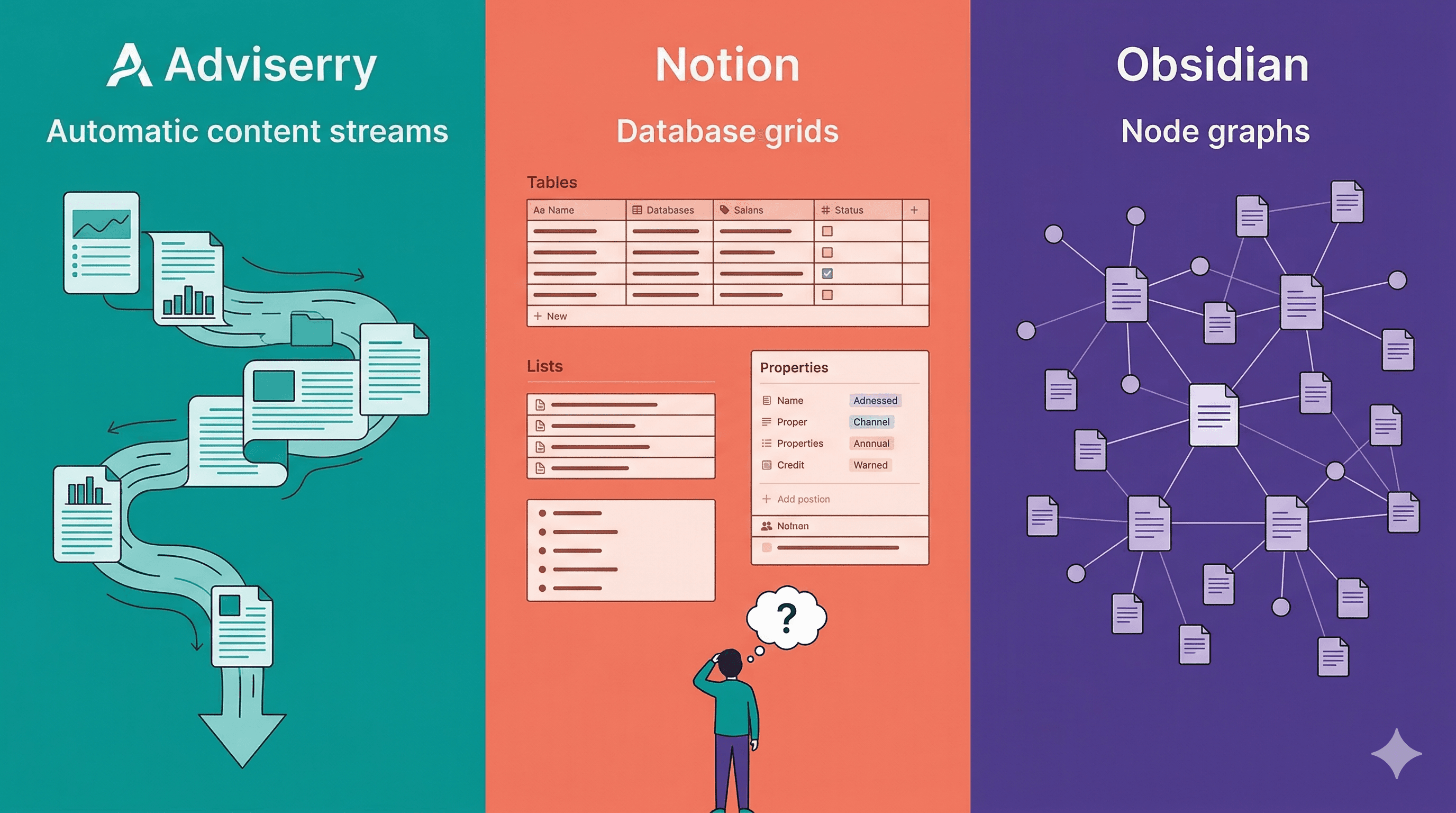
Adviserry is for people who want their knowledge base to build itself from their subscriptions.
Notion is for people who want to build their knowledge base manually in an all-in-one workspace.
Obsidian is for people who want to build their knowledge base manually with maximum control and local ownership.
If one of those sentences made you immediately think "that's me," you probably already know your answer.
Adviserry Boards: the automatic approach.
Full disclosure: I built Adviserry. I'm going to describe it fairly, but you should know that.
What it does: connects to your Gmail, discovers your newsletters, adds your YouTube channels, and automatically extracts, summarizes, and indexes all the content. You organize sources into topic boards and interact through search, AI chat, or MCP server in Claude Desktop.
Where it shines: if your knowledge comes primarily from newsletters, YouTube, and podcasts you subscribe to, and you want that knowledge to be searchable without doing any manual work. Connect once, and your knowledge base grows automatically every time someone you follow publishes something.
Where it falls short: it's focused on subscription content. If your knowledge comes from your own notes, meeting transcripts, random web articles, or internal documents, Adviserry isn't the primary tool for that. (You can upload context documents, but the core value is the subscription-to-knowledge pipeline.)
Cost: $99.99 lifetime for Core, $19.99/month for Pro with AI Chat.
Best for: overwhelmed subscribers who follow great content but can't retain it.
Notion AI: the all-in-one approach.
What it does: Notion is a workspace for docs, databases, wikis, and project management, with AI layered on top. Notion AI can answer questions across your workspace, summarize docs, and help you write.
Where it shines: if you already use Notion for everything (or are willing to), the AI search becomes powerful because it has access to all your work. Notes, project docs, meeting notes, personal wiki, reading database, all queryable. The flexibility is incredible. You can build basically anything.
Where it falls short: you have to put everything into Notion yourself. Every newsletter you want searchable, every podcast note, every article summary. It's a great brain, but you're the one feeding it, every single day. The people I know who make Notion work as a knowledge base are either very disciplined or have VAs doing the data entry.
Cost: Free for personal, $10/month for Plus with AI, $25+/month for teams.
Best for: people who already live in Notion and want AI search across their existing workspace.
Obsidian: the local-first power user approach.
What it does: local markdown files with a powerful linking system, graph view, and hundreds of community plugins. AI capabilities come from plugins like Smart Connections, Copilot, and others.
Where it shines: if you value owning your data (local files, not cloud-dependent), want maximum customization, and enjoy the process of building and maintaining a knowledge graph. The backlinks and graph view create connections between ideas that no other tool matches. It's beautiful when it works.
Where it falls short: same manual input problem as Notion, plus a steeper learning curve, plus the plugin ecosystem can be unstable. You need to write notes, maintain links, and actively build your vault for it to be useful. If you stop for a week, nothing happens in your vault (because nothing happens without you).
Cost: $Free for personal use. Sync is $4/month.
Best for: power users who enjoy building systems and want full control over their data.
The honest comparison on what matters:
How much manual work is required? Adviserry: almost none after setup. Notion: moderate to high, ongoing. Obsidian: high, ongoing.
How quickly do you get value? Adviserry: within an hour of connecting Gmail. Notion: weeks to months of building your workspace. Obsidian: weeks to months of building your vault.
How good is the AI? Adviserry: focused on subscription content, good at cross-referencing experts, RAG-based chat with citations. Notion: broad search across your workspace, general AI writing assistance. Obsidian: depends on which plugins you use, can be hit or miss.
What if you stop using it for a month? Adviserry: your knowledge base keeps growing (content auto-syncs). Notion: nothing changes (but nothing was auto-added anyway). Obsidian: nothing changes.
My actual recommendation:
Use Adviserry for your subscription content (newsletters, YouTube, podcasts). It does this one thing better than anything else because it was designed specifically for it, and it requires zero maintenance.
If you also need a workspace for your own notes, documents, and projects, add Notion or Obsidian alongside it. Not instead of it. The tools complement each other because they solve different problems.
The biggest mistake people make: trying to use one tool for everything. A tool optimized for manual knowledge building (Notion, Obsidian) and a tool optimized for automatic subscription ingestion (Adviserry) work better together than either one alone.
Pick based on your actual behavior, not your aspirational behavior. You'll be happier with the result.