Business Coaching Is a $7.3 Billion Industry. Here's Why It's About to Be Disrupted.
Business Coaching Is a $7.3 Billion Industry. Here's Why It's About to Be Disrupted.
Here's a number that bothers me: $7.3 billion.
That's the approximate annual revenue of the global business coaching industry. It's been growing steadily for a decade. By most projections, it'll clear $10 billion before the end of this one.
Here's what bothers me about that number: almost none of it flows to the founders who need coaching the most.
The coaching market serves the top of the market.
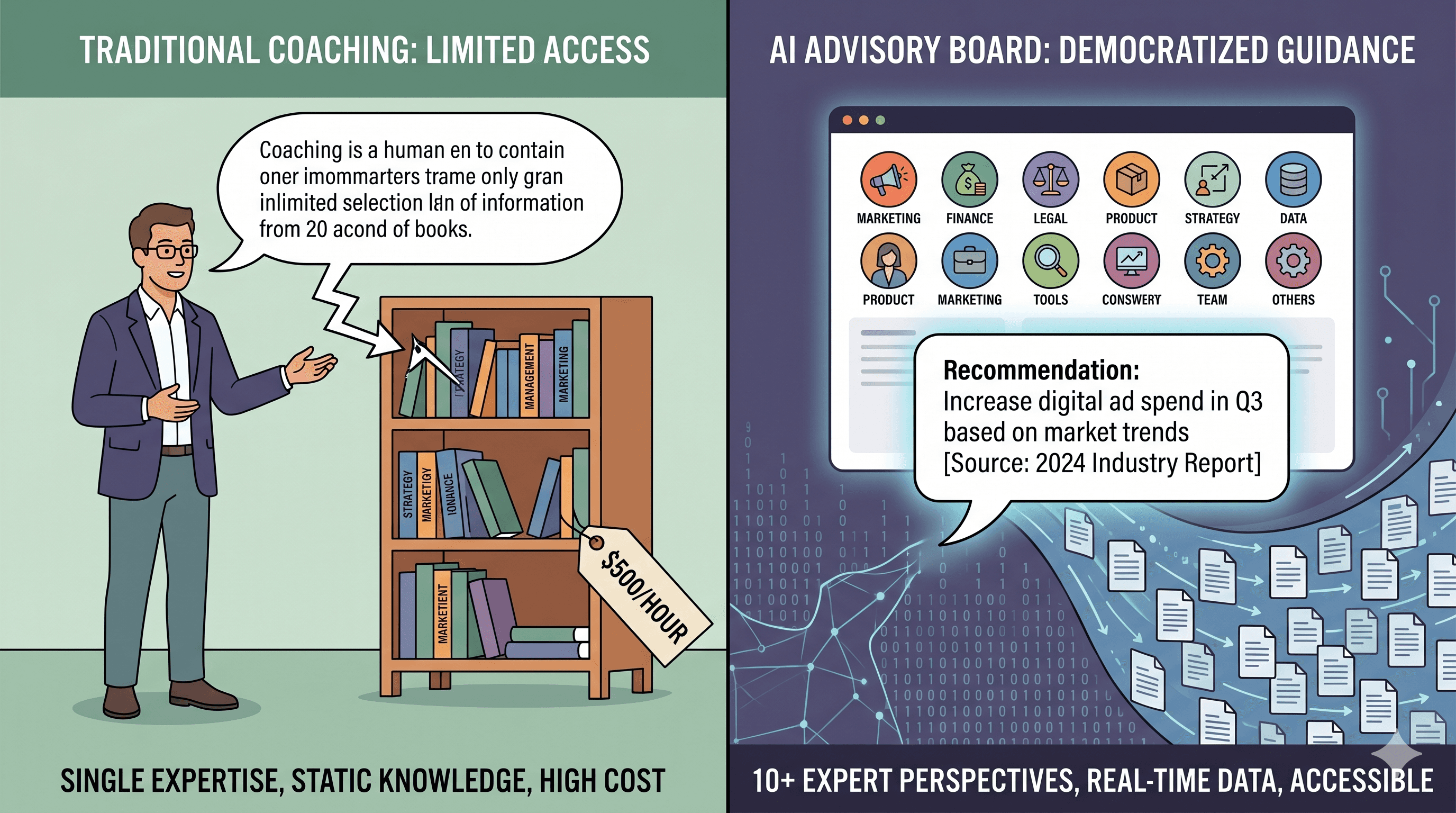
Executive coaches at the high end — the ones you actually want, with real track records and specific expertise — charge $500 to $1,500 per session. At four sessions a month, that's $2,000 to $6,000 a month. Annually, you're looking at $24,000 to $72,000 for one person's perspective.
That price point works for a Fortune 500 executive with a six-figure discretionary budget. It works for a founder who just raised a $10M Series A and is now managing 40 people for the first time. It does not work for the bootstrapped SaaS founder at $300K ARR trying to figure out whether to hire a sales rep or invest in SEO. It doesn't work for the solo consultant building a productized service. It doesn't work for the $2M-revenue small business owner who is, frankly, making harder decisions than most of the executives paying the premium rates.
[Image suggestion: A pyramid showing business sizes — Fortune 500 and Series A+ at the top (labeled "coaching accessible"), a vast middle (SMB founders, bootstrapped SaaS, solopreneurs) labeled "coaching inaccessible," with a dotted line showing where the price wall sits]
The current model has a structural problem.
Coaching is expensive because it's human-time-intensive by design. One coach can serve maybe 10-15 clients intensively. Supply is capped. Prices reflect that. The coaches who are genuinely excellent become more expensive as they become known, which makes them less accessible to the people who'd benefit most from working with them.
This is a market structure problem, not a quality problem. The coaches aren't extracting unfair rents. They're just expensive in the way that any scarce, skilled, in-person service is expensive.
AI changes the supply side of that equation entirely.
What disruption actually looks like here.
This isn't the "AI replaces coaches" narrative. That framing is too simple and, frankly, wrong in important ways. Human coaches offer things AI doesn't — personal accountability, emotional attunement, relationship-built trust. Those things have real value and won't evaporate.
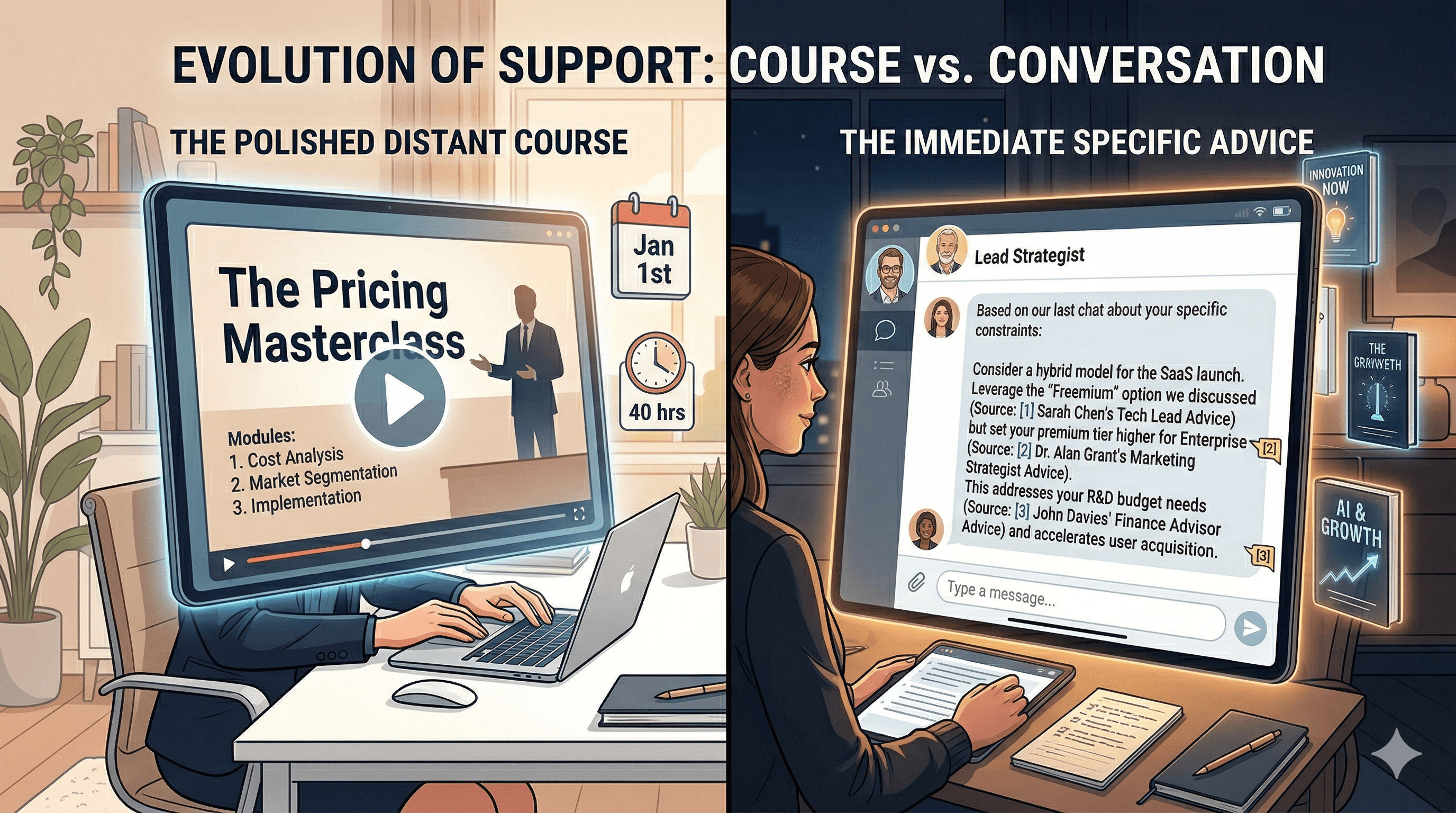
What AI disrupts is the access problem. An AI advisory board that synthesizes expert perspectives from the sources you already trust, knows your business context, and is available on-demand — that's not a worse version of coaching. It's a different product that serves a different use case for a very large underserved market.
The $500K-$5M revenue founder who can't justify $36K/year for a single coach but desperately needs strategic input? That's the market. It's enormous. And until recently, no one was serving it well.
The disruption isn't that AI beats the best human coaches. It's that AI makes something coaching-adjacent accessible to the 95% of founders the coaching industry was never really built for in the first place.
$7.3 billion is a big number. But it's small relative to the market that's been invisible.
Keep Reading:
- How I Replaced My $5,000/Year Coaching Program — the personal version of this disruption
- 10 Best Ways to Use AI as a Business Advisor — practical AI advisory use cases
- How to Set Up Your First Adviserry Board in 5 Minutes — try it for yourself
Image Prompts:
- An editorial-style market map showing a large "coaching industry" circle labeled $7.3B, with a smaller portion highlighted as "accessible to most founders" — and a much larger circle next to it labeled "underserved founder market." Clean, infographic style with a slightly provocative edge.
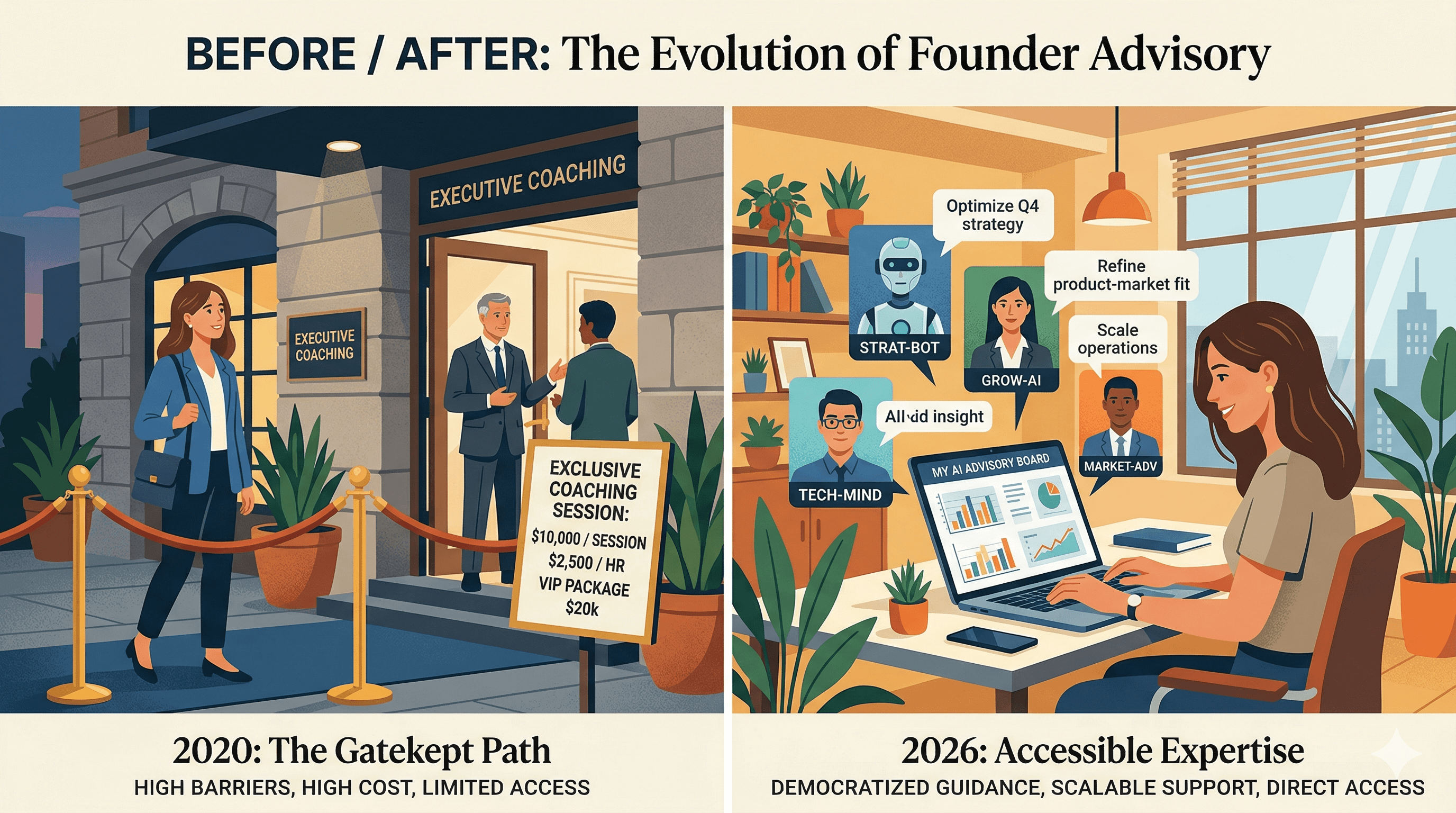
- A before/after illustration: "2020" shows a velvet rope outside an exclusive coaching session (price tags visible); "2026" shows a founder at a laptop with an AI advisory board, same quality of advice, no velvet rope. Flat design, editorial color palette.