Do You Need a Second Brain App or an AI Advisory Board? Here's How to Decide
Do You Need a Second Brain App or an AI Advisory Board? Here's How to Decide
These two categories of tools get lumped together constantly, and I get why. They're both about "being smarter with the knowledge you have." They both involve AI. They both promise to help you remember things and make better decisions.
But they solve fundamentally different problems, and picking the wrong one means you'll either do a lot of work for little payoff or miss out on value you didn't know was available.
Here's the actual difference, stripped of marketing language.
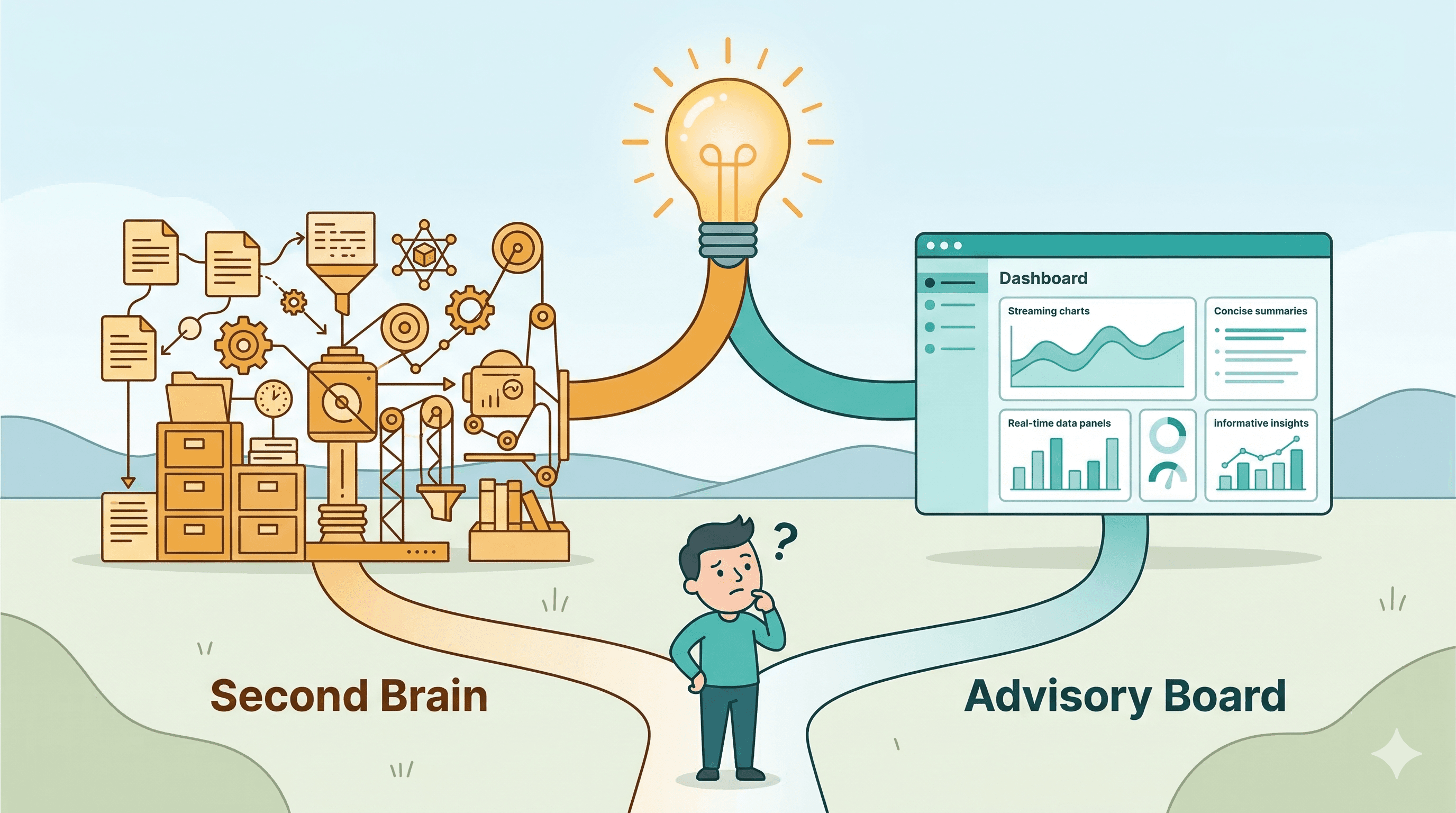
Second brain apps organize what you manually put in.
Notion, Obsidian, Mem, Roam Research. These tools give you a place to capture your thoughts, notes, highlights, and references. You write notes. You tag them. You link them. Over time, you build a personal knowledge graph that represents your thinking.
The value comes from two things: the process of writing (which forces you to think through ideas) and the archive of your thinking (which you can search and reference later).
The critical requirement: you have to do the work. Every note, every link, every tag. The system is exactly as rich as the effort you put in. If you stop adding to it for a month, it stops growing. If you never added certain content, it doesn't exist in your system.
AI advisory boards organize what you subscribe to.
Adviserry Boards (which I built, disclosure out of the way) is the primary example here, though Notebook LM partially covers this ground for manual uploads. These tools take external content (newsletters, YouTube, podcasts) and automatically process, summarize, and index it into a queryable knowledge base.
The value comes from making the expertise you already subscribe to accessible and searchable, without manual processing.
The critical requirement: you have to subscribe to good content. The quality of the system depends entirely on the quality of your sources. But once you've curated your sources, the system maintains itself.
The diagnostic questions:
Where does your knowledge come from? If it's primarily from your own thinking, observations, meeting notes, and original ideas, you need a second brain. If it's primarily from newsletters, podcasts, YouTube, and other people's published content, you need an advisory board.
How disciplined are you about maintenance? If you genuinely enjoy daily note-taking and have maintained the habit for 3+ months, a second brain will serve you well. If you've started and abandoned note-taking systems multiple times (hi, that's me), an advisory board removes the maintenance bottleneck.
What do you actually need to retrieve? If you need to find your own thoughts and connections ("what did I think about this last quarter?"), second brain. If you need to find expert advice and frameworks ("what did Hormozi say about this?"), advisory board.
How many content sources do you follow? If you subscribe to 5 or fewer sources and read them all carefully, manual processing is manageable. If you subscribe to 15+ sources and can't keep up, automated processing is the only realistic approach.
The overlap and the complement.
There is some overlap. Both systems give you a searchable knowledge base. Both can help you make better decisions by surfacing relevant information.
But they're better together than either one alone.
Use an advisory board (Adviserry) for external expert knowledge. It handles the volume of subscription content that no manual system can keep up with. Your newsletters and YouTube channels get processed automatically. You search and chat when you need expert input.
Use a second brain (Notion, Obsidian) for internal knowledge. Your own ideas, meeting notes, project reflections, decision logs. The stuff only you can create because it comes from your own experience and thinking.
The advisory board is your library of other people's expertise. The second brain is your journal of your own thinking. Together, they cover the full spectrum of knowledge a founder needs.
If you can only pick one:
Be honest about your behavior, not your aspirations.
If you will maintain a daily note-taking practice for the next six months, pick a second brain. You'll build something genuinely powerful.
If you won't (and statistically, most people won't), pick an advisory board. It'll work whether you're disciplined or not, and it'll still be active and useful in six months.
There's no shame in picking the lower-maintenance option. The best knowledge system isn't the most impressive one. It's the one you're still using.
Choose accordingly. You know yourself better than any comparison article does.