How a Solo Consultant Could 3x Revenue With an Advisory Board
How a Solo Consultant Could 3x Revenue With an Advisory Board
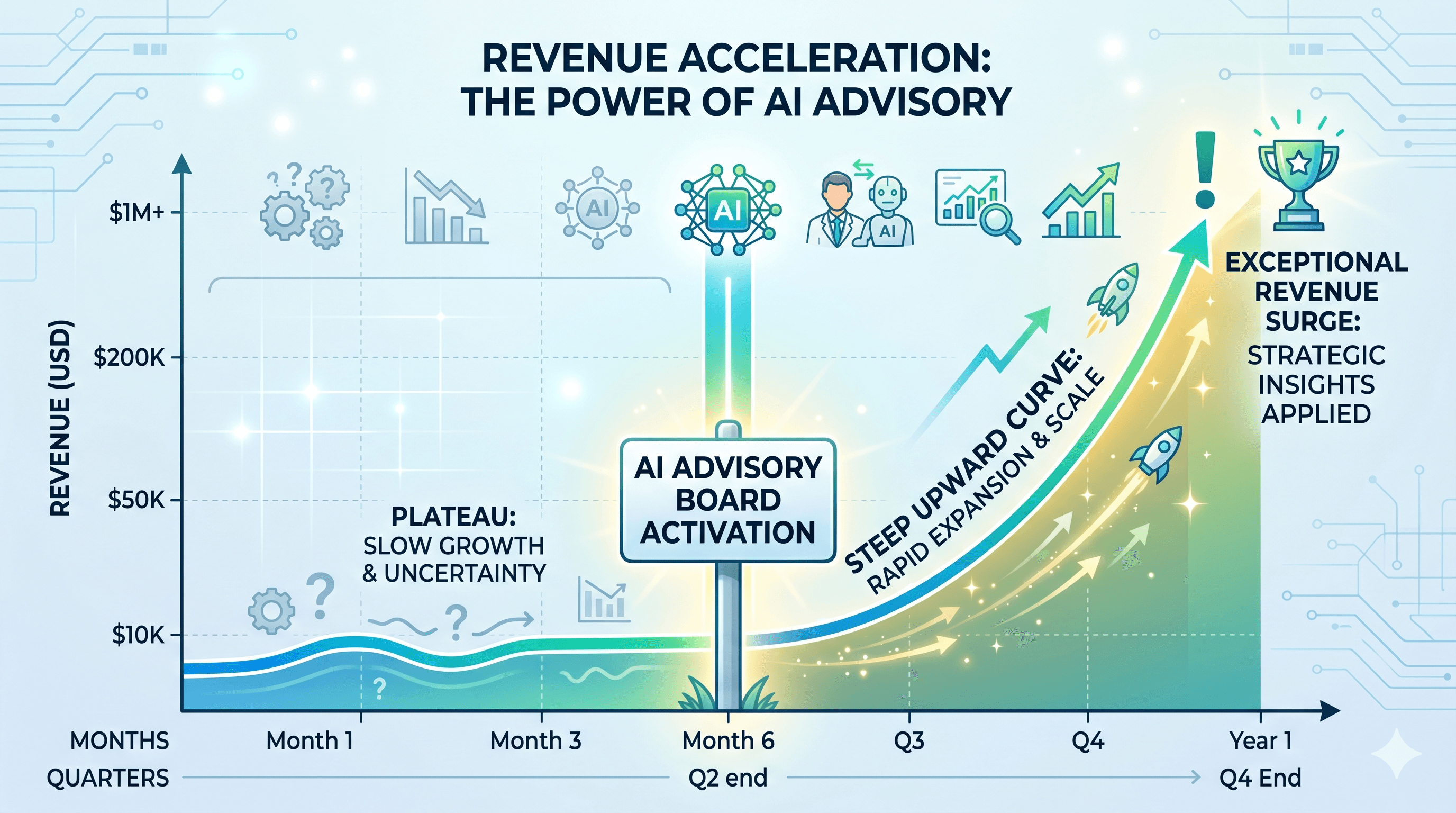
This is a worked example, not a customer story. "Sarah" is a composite of the independent consultants who hit the same wall: good work, loyal clients, and a revenue plateau that more hours cannot fix. The numbers below show the shape of the change when a pricing shift lands. They are illustrative, not a result we are claiming on anyone's behalf.
Worth walking through in detail, because the plateau has a specific cause and it is almost never effort.
What the plateau actually is
Sarah runs a one-person UX consulting practice, four years in. She is good at it: clients stay, they refer her, she has never had to cold prospect. She hit a ceiling around year two and has not moved past it.
She has tried the usual things. A $2,000 mastermind with good energy and generic advice. One session with a business coach who told her to "niche down", which she already knew. Courses teaching frameworks she could not map onto her own situation.
She follows Tara McMullin, Jonathan Stark, and a few other independent-consulting writers. She reads their newsletters. She rates their thinking highly. What she cannot get is the situation-specific version of their advice.
That is the access problem, and it is the real constraint. Not information. Access to the application of it.
What building the panel looks like
She points an AI advisory panel at two years of content from the writers she already follows, then adds a short brief about her own business: what she sells, to whom, at what rate, current revenue, and where growth is stuck.
Then she asks the questions she has been sitting on. Not hypotheticals. The real one:
"I have been doing UX consulting at $150/hour. Jonathan Stark argues for value-based pricing. How do I actually make that transition without losing my current clients?"
A general chatbot answers that from the open internet. A panel built from her sources answers it from Stark on the hourly-to-value transition, McMullin's frameworks on positioning a change to existing clients, and the friction points those writers have already documented. Same question, different provenance, and the second one arrives with citations she can go read.
What comes back is a sequence, not a slogan. Which clients to move first, what to say, what to expect when someone pushes back.
What eighteen months of executing on it could look like
Legacy clients at $220/hour. New clients on an engagement model structured around outcomes instead of time. Average project revenue up roughly 3x. A waitlist, for the first time.
Now the honest part. Would that be the software? No. She would have done the work, made the calls, and had the uncomfortable pricing conversations. What changes is that she goes into them with a framework sourced from people she already trusts, instead of going in on nerve.
That is the realistic claim for this category. It does not make the decision. It removes the excuse that you do not know how.
FAQ
Is this a real customer story?
No. It is a composite worked example, labelled as one. The pattern it describes (a capable independent consultant stuck behind an access problem rather than an information problem) is common, but "Sarah" is not a customer and the figures are illustrative.
What is the difference between this and asking ChatGPT the same question?
Provenance. A general assistant answers from the open web and has no memory of what you read last month. A panel built from your own sources answers only from the writers you chose and cites the issue it drew from, so you can check the reasoning against someone whose judgement you already trust.
Do I need two years of a creator's archive for this to work?
No, though more helps. The useful threshold is enough material for the writer's actual position on a topic to be visible rather than a single post about it. Connecting a newsletter you already subscribe to gets you there faster than you would expect, because the back catalogue comes with it.
What does an AI advisory panel cost?
Adviserry Pro is $49 per month with a 7-day free trial. For comparison, a formal advisory board involves equity grants and quarterly commitments, and a business coach typically runs from several hundred to a few thousand dollars a month.
Keep reading: