My Business Coach Told Me to 'Trust the Process.' My AI Advisor Gave Me the Data.
My Business Coach Told Me to 'Trust the Process.' My AI Advisor Gave Me the Data.
I want to be fair here. "Trust the process" is not always terrible advice. Sometimes the problem really is that you're impatient with a strategy that would work if you gave it more time. Sometimes the advice is right.
But here's when it's not useful: when the process isn't working and you need to know why.
I was three months into a content marketing strategy that my coach had helped me design. We'd been thoughtful about it. I'd executed it diligently. The results were, charitably, underwhelming. I brought this to our session. His response, delivered with warmth and genuine belief: "Stay with it. Trust the process. You're building an asset that takes time."
I did not find this satisfying.
The platitude problem.
Good coaching is not platitude delivery. But some percentage of coaching time, particularly when the coach doesn't have the specific data or frameworks to diagnose your actual problem, ends up in platitude territory. Trust the process. Be patient. Bet on yourself. Stay consistent.
These things are sometimes true. They're almost never specific enough to be useful when you're trying to diagnose a problem.
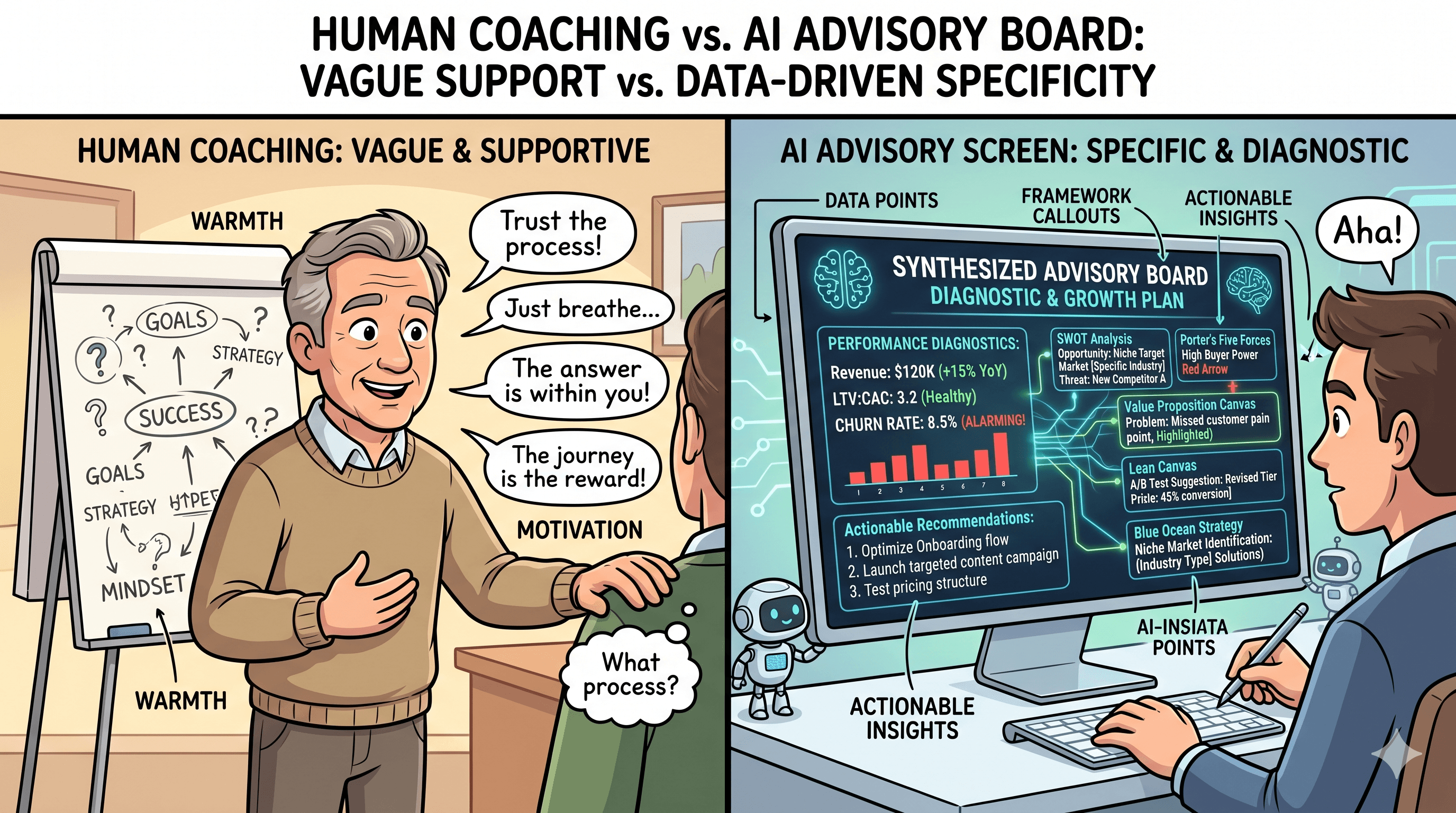
[Image suggestion: Two side-by-side chat windows: one labeled "Business Coach" with a warm, vague response about patience and process; one labeled "AI Advisory Board" with a specific diagnosis citing a churn rate benchmark and a framework for testing the core assumption. Same question, different quality of answer. Slightly wry, editorial style.]
What I actually needed.
When I asked my AI advisory board the same question — "my content marketing strategy isn't generating leads after three months, what's likely going wrong?" — I got something different.
A diagnostic framework from one of my expert sources that identified the three most common failure modes for founder-led content marketing at my stage. A benchmark from Lenny's research on organic content timelines for B2B SaaS. A specific set of questions to test whether the problem was content quality, distribution, keyword selection, or conversion — with suggestions for the fastest way to test each hypothesis.
The board didn't tell me whether the process was worth trusting. It told me what to look at to answer that question myself. That's the difference between a platitude and a framework.
In defense of human coaches (a small one).
Here's the fair part: my coach was right that I was being impatient. The content strategy did eventually produce results, once I made three specific adjustments that the AI board helped me identify. He wasn't wrong. He just didn't have the specific expertise to give me the diagnostic tools I needed.
That's not a character flaw. It's a knowledge breadth limitation. A human coach has one career's worth of experience. "Trust the process" is sometimes the honest answer when that experience doesn't include a specific diagnosis for your specific problem.
The AI advisory board, with its access to expert sources across multiple domains, can often provide what the generalist coach cannot: the specific framework, the relevant benchmark, the diagnostic question set.
Not more warmth. More data. Which, for a certain type of founder facing a certain type of problem, is what actually helps.
The process is worth trusting when you can verify it's not broken. That requires data. Get the data.
Keep Reading:
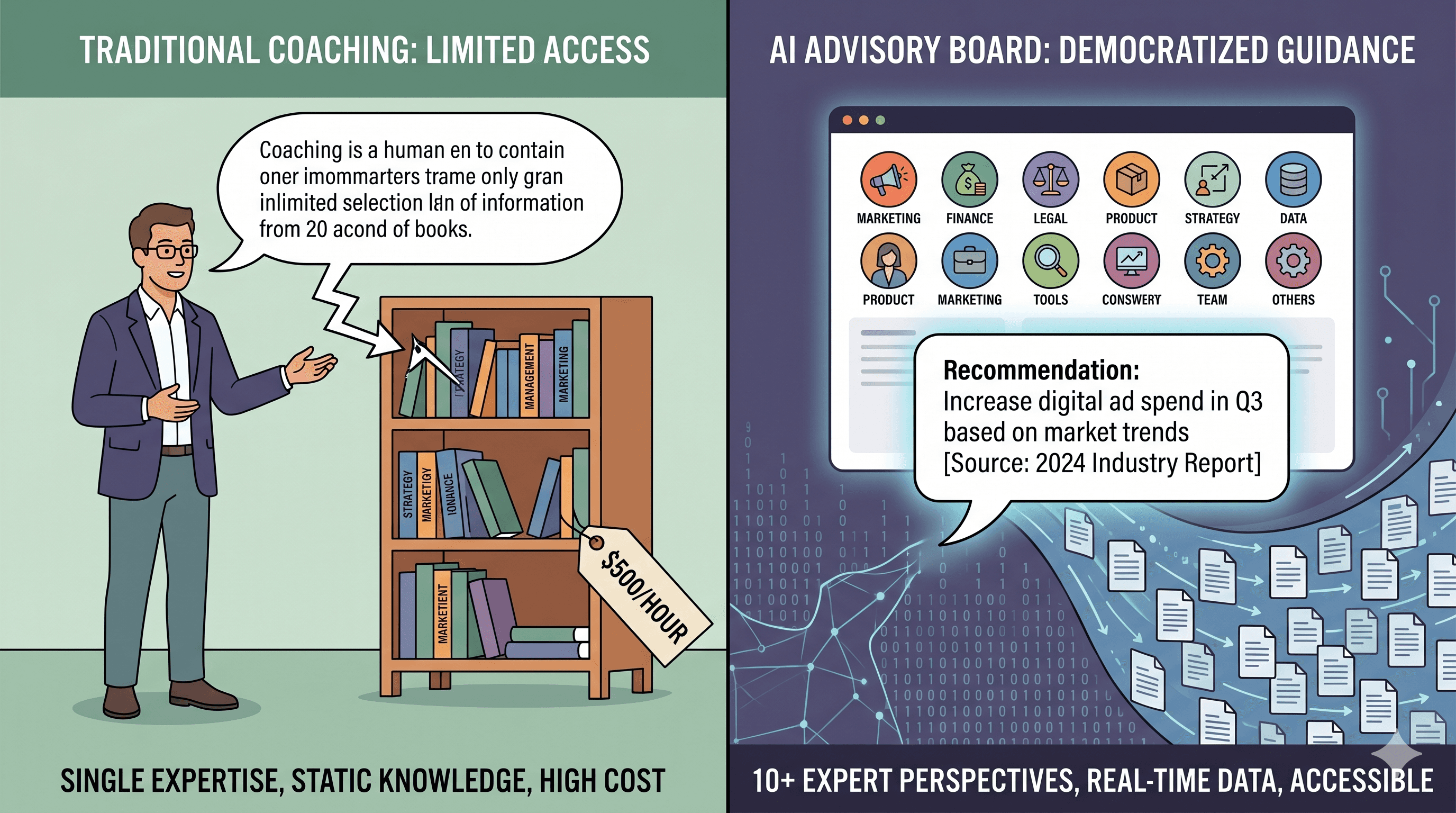
- How I Replaced My $5,000/Year Coaching Program — the full coaching vs. AI comparison
- How to Cross-Reference Advice From Multiple Experts — getting specific frameworks, not platitudes
- Why You Forget 90% of What You Read — why coaching advice evaporates
Image Prompts:
- A cartoon-style split: a coach in a supportive but vague mode ("Trust the process!") vs. an AI advisory board screen showing a specific diagnostic breakdown with data points and framework callouts. Slightly wry, clearly editorial — the humor is affectionate, not mean.
- A "vague advice vs. specific advice" visual: word cloud on one side with terms like "trust," "process," "patience," "consistency"; structured framework on the other side with specific diagnostic steps and data benchmarks. Clean contrast, infographic style.