Second Brains Are Broken — They Require You to Do All the Work
Second Brains Are Broken — They Require You to Do All the Work
I've read Building a Second Brain by Tiago Forte. Twice. I've watched the videos. I've set up the Notion template. I've built the Obsidian vault with the folder structure and the daily note template and the tag taxonomy.
Three times. I've done this three times. Each time, the setup phase was exciting. "This is going to change everything." Each time, the maintenance killed it within six weeks.
And I don't think this is a me problem. Based on every conversation I've had with other founders and knowledge workers who've tried the same thing, the dropout rate is astronomical. People love the idea of a second brain. They love setting it up. They hate maintaining it. So they stop.
The concept isn't wrong. Having an external system that captures, organizes, and resurfaces knowledge so your brain can focus on thinking? That's brilliant. That's clearly the right direction.
The execution is broken. And it's broken in one specific, fixable way.
Every second brain tool puts the burden on you.
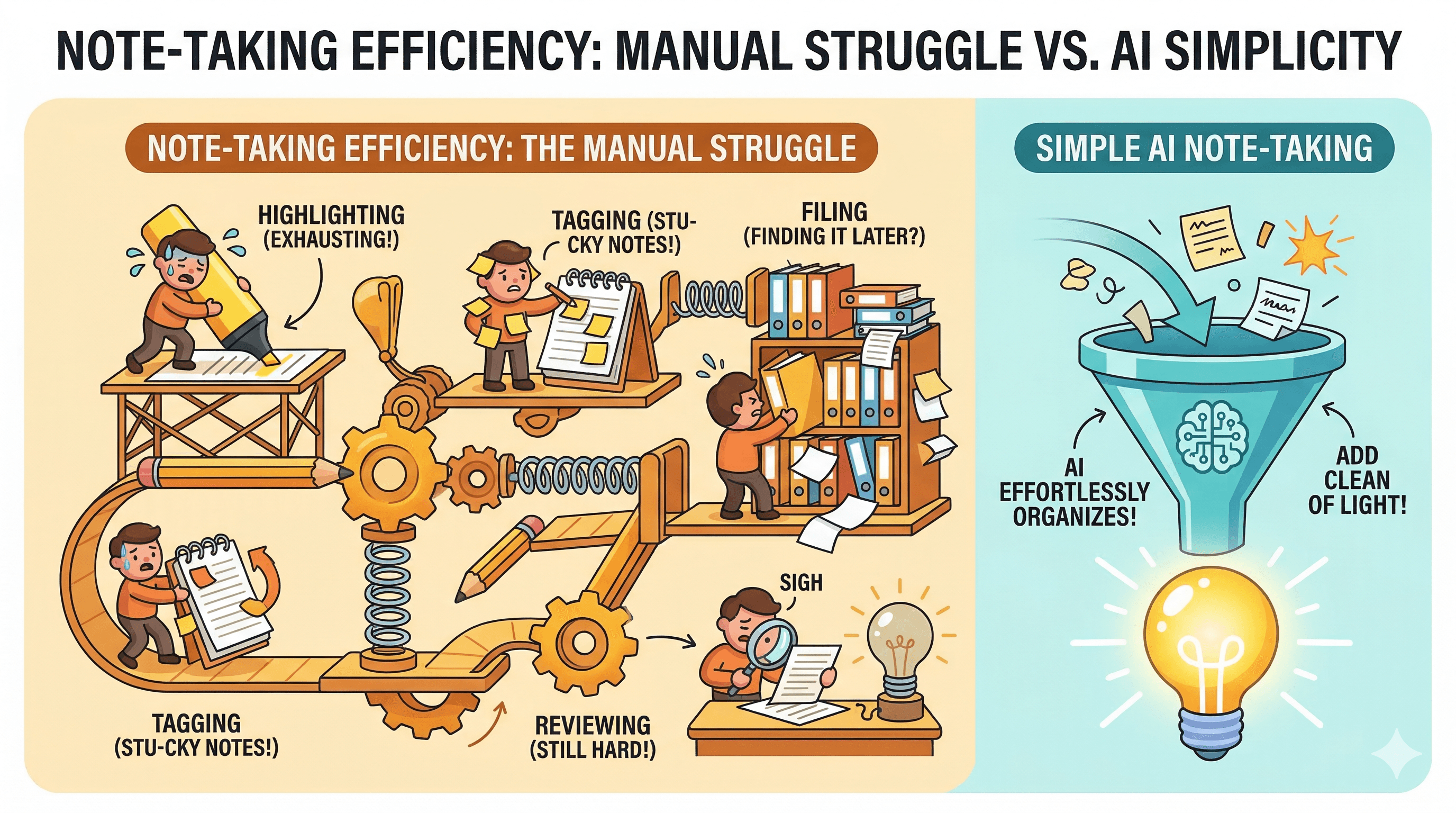
Read an article? You highlight the key parts. Listen to a podcast? You take notes. Find a useful framework? You create a note, tag it, link it to related notes, file it in the right folder. Get a newsletter? You paste the relevant sections into your system, add metadata, and make sure it's connected to your existing notes.
This is hours of work per week. Ongoing. Forever. And it's the worst kind of work: administrative work that feels productive but isn't actually doing anything for your business. You're not thinking. You're filing.
The second brain evangelists will tell you that the act of processing information is itself valuable. That taking notes forces you to engage with the material more deeply. And they're right, in theory. In practice, most people don't do it because the overhead is too high and the payoff is too delayed.
The failure mode is always the same.
Week 1: Set up the system. Feel amazing.
Week 2: Diligently process every article and podcast. Feel productive.
Week 3: Start skipping some items. "I'll add those later."
Week 4: "Later" pile grows. Guilt accumulates.
Week 5-6: Stop using the system entirely. "I'll restart when things calm down."
Things never calm down. The system stays abandoned. The guilt lingers.
I know this pattern because I've lived it three times. And the reason I kept trying is because the underlying need is real. I genuinely need a way to capture and retrieve knowledge. The tools just kept failing me at the maintenance step.
What needs to change: input automation.
The fix isn't better note-taking habits. It's eliminating the need for manual input.
Your newsletters are already arriving in your inbox. They don't need you to copy-paste them anywhere. They need to be automatically extracted, summarized, and indexed.
Your YouTube subscriptions are already publishing content. They don't need you to transcribe and annotate them. They need to be automatically transcribed, processed, and made searchable.
Your podcast subscriptions are already creating episodes. Same thing.
The second brain should build itself from the content streams you already have. Your job should be choosing who to follow (curation) and asking questions when you need answers (retrieval). Everything in between should be automated.
That's why I built Adviserry Boards. Not because the second brain concept is wrong, but because the implementation has been wrong. Connect your Gmail, add your YouTube channels, and the system builds itself. No daily maintenance. No filing. No tagging. No guilt when you skip a week.
What a working second brain actually looks like:
Input is automatic. Content flows in from your subscriptions without any action from you.
Organization is AI-driven. Topic boards provide structure without requiring manual taxonomy.
Retrieval is on-demand. You search or chat when you have a question, not when you have time to browse.
The archive compounds. Every new newsletter issue and YouTube video makes your knowledge base deeper. You don't maintain it. It grows on its own.
I'm not saying manual note-taking is worthless.
If you're one of those people who genuinely enjoys the process of taking notes, linking ideas, and building a personal wiki, that's great. Keep doing it. Obsidian and Notion are powerful tools for you.
But if you're like me, and you've tried and failed at the manual approach multiple times, stop blaming your discipline. The tool is asking too much of you. It's a design problem, not a character problem.
The best second brain is the one that works six months from now, not just six days from now. And the only way to get there is to remove yourself from the maintenance loop.
Build a brain that feeds itself. You've got better things to think about.