The $50K Advisory Board vs. The $15/Month One: What You Actually Get
The $50K Advisory Board vs. The $15/Month One: What You Actually Get
Let's talk about what advisory boards actually cost, because most founders have no idea.
A formal advisory board — the kind with equity grants, quarterly meetings, and actual accountability — typically involves giving each advisor 0.1% to 0.5% of your company. At a $10M valuation, that's $10,000 to $50,000 per advisor, in equity, per person. Add three or four advisors and you've allocated somewhere between $30K and $200K in company value before you've gotten a single piece of advice.
Then there's the informal version. The "I'll buy you coffee and you tell me what you think" advisory relationship, which is basically free but produces advice on demand from exactly one person whose time is already spoken for.
Neither of these works particularly well for most founders. The formal version is expensive and often under-delivers (quarterly check-ins are rarely when you need help). The informal version is great for one person's opinion when they happen to be available.
What you're actually paying for.
The value proposition of a traditional advisory board is access and credibility. Access to smart, experienced people who've solved problems like yours. Credibility when you're fundraising or hiring. Those things are real. I don't want to minimize them.
But access and credibility are not the same as answers. And most founders need answers more than they need either.
When I think about what I actually wanted from an advisory board — strategic input on the questions I couldn't answer myself, specifically and on-demand — the traditional model fails at both. Strategic input that comes four times a year is strategic input that arrives after most decisions have already been made.
What an AI advisory board actually gives you.
Let me be direct about this. An AI advisory board built from your curated expert sources — the newsletters, podcasts, and content from people you already follow — gives you three things a traditional board rarely does.
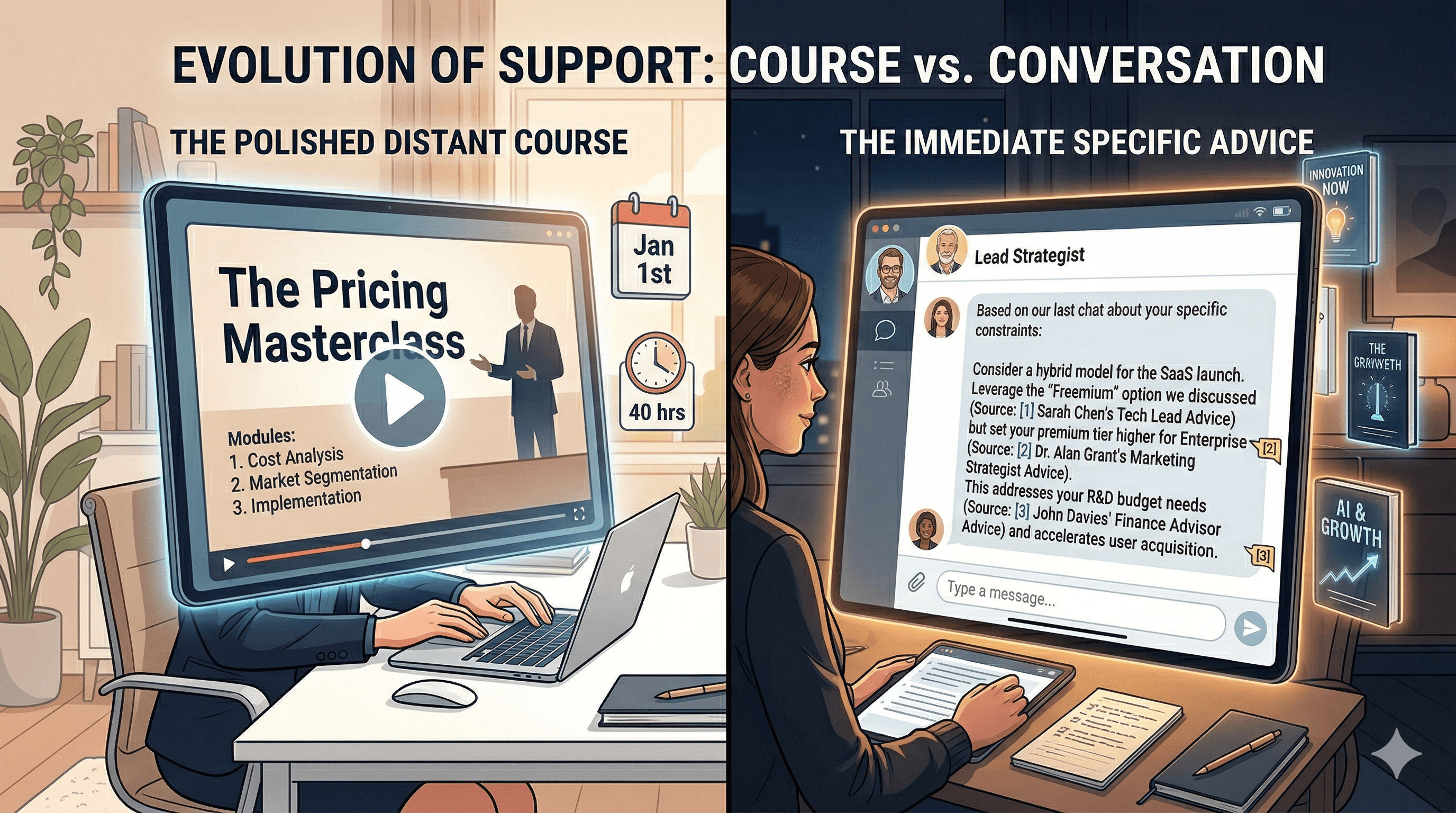
Availability. The question you have at 9pm on a Friday gets answered at 9pm on a Friday. Not at next quarter's advisory call.
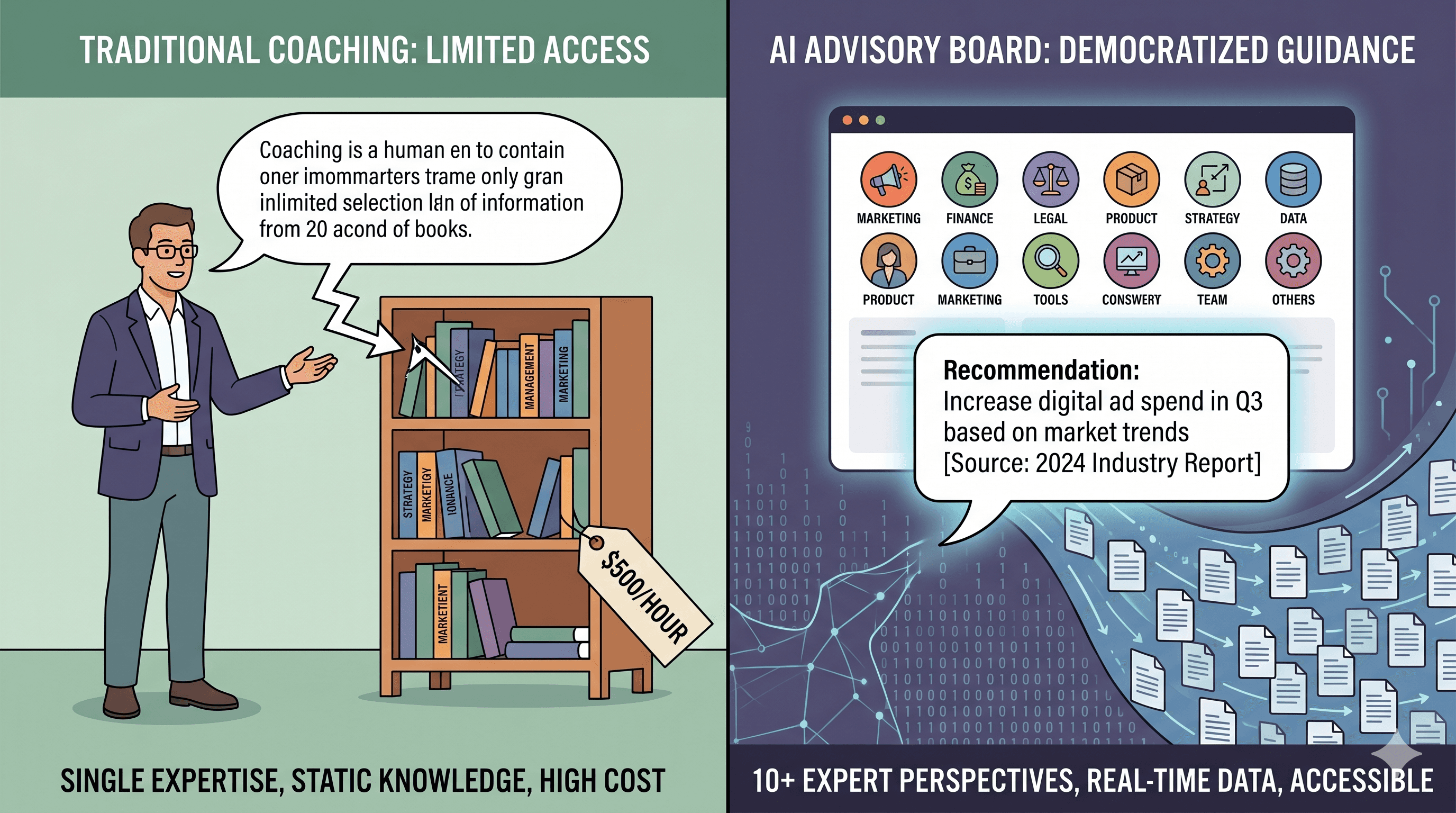
Breadth. Instead of three or four advisors, you have whatever your source library contains — potentially dozens of expert perspectives across every domain relevant to your business.
Context retention. You upload your strategy doc, your pitch deck, your pricing model. Your board knows your business. Every conversation builds on the last.
What it doesn't give you.
Warm intros. The handshake that gets you in front of an investor. The social proof of "backed by [name]." Those things are real and valuable, and an AI advisory board won't provide them.
Personal accountability. A human advisor who texts you the morning of a big meeting because they know you have one. That's relationship. That's not replicable in software, at least not yet.
If you need those things — if you're raising a round and you need the credibility signal, or if you need a mentor who knows you personally — build a traditional board. The equity is probably worth it.
If you need fast, smart, specific, on-demand strategic guidance for $15 a month? That math is a lot easier.
Keep Reading:
- Why Every Founder Needs a Personal Board of Advisors — building an advisory board without equity
- How to Build a "SaaS Founder" Advisory Board — step-by-step with recommended sources
- How I Replaced My $5,000/Year Coaching Program — the real cost comparison
Image Prompts:
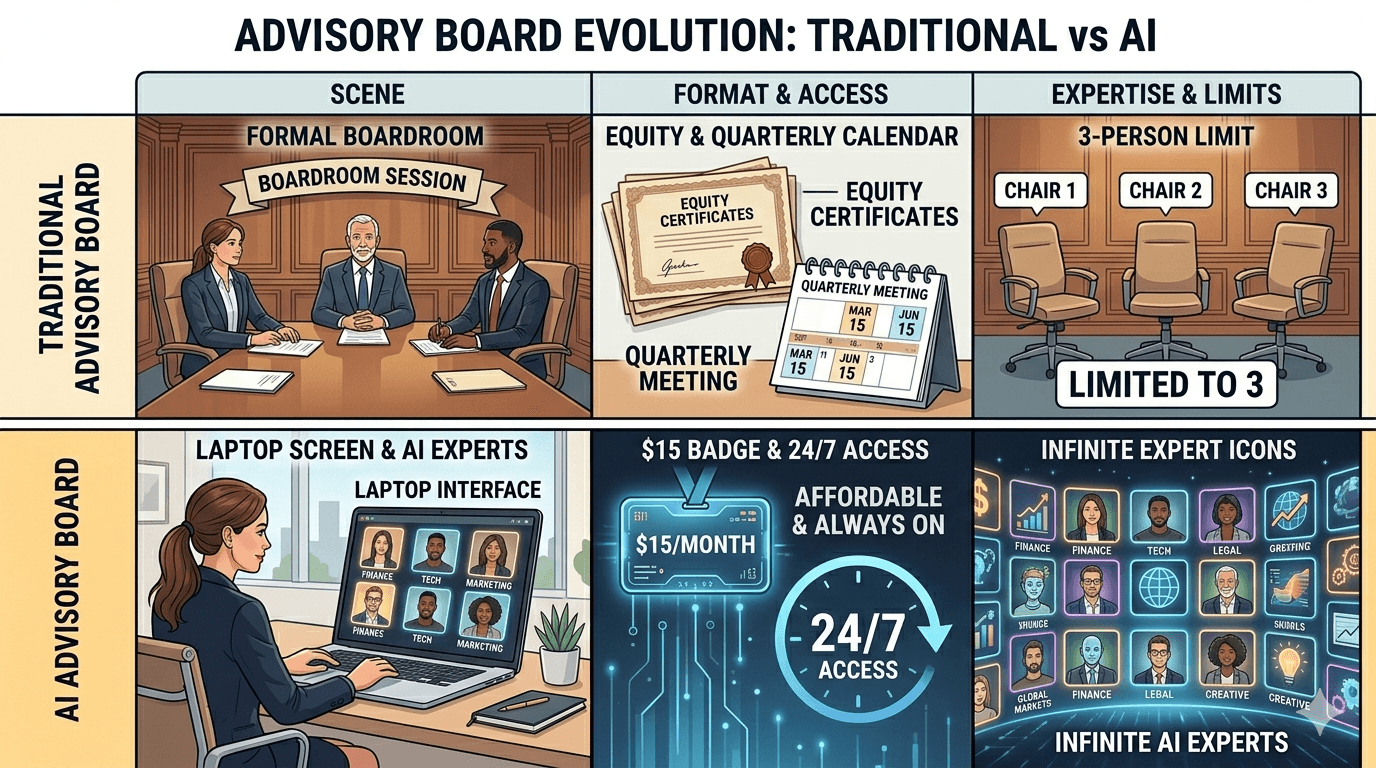
- An illustrated comparison table with two rows: "Traditional Advisory Board" (formal boardroom, equity certificates, quarterly calendar, three-person limit) vs. "AI Advisory Board" (laptop screen, $15 badge, 24/7 clock, infinite expert icons). Clean infographic style with a light, slightly playful aesthetic.
- A scale illustration with a heavy gold bar labeled "$50K equity" on one side and a glowing phone showing an AI advisory interface on the other — balanced, with a question mark above suggesting the choice. Minimal, editorial style.