Why You Forget 90% of What You Read (And How AI Fixes It)
Why You Forget 90% of What You Read (And How AI Fixes It)
Last week I read a fantastic newsletter issue about conversion optimization. Specific tactics, real numbers, frameworks I could apply immediately. I remember being excited about it. I remember thinking "I need to use this."
Can I tell you a single specific thing from that issue right now? I cannot.
This isn't a me problem. It's a brain problem. And once you understand why it happens, you stop blaming yourself for bad memory and start building systems that work around it.
Your brain is a forgetting machine (and that's on purpose).
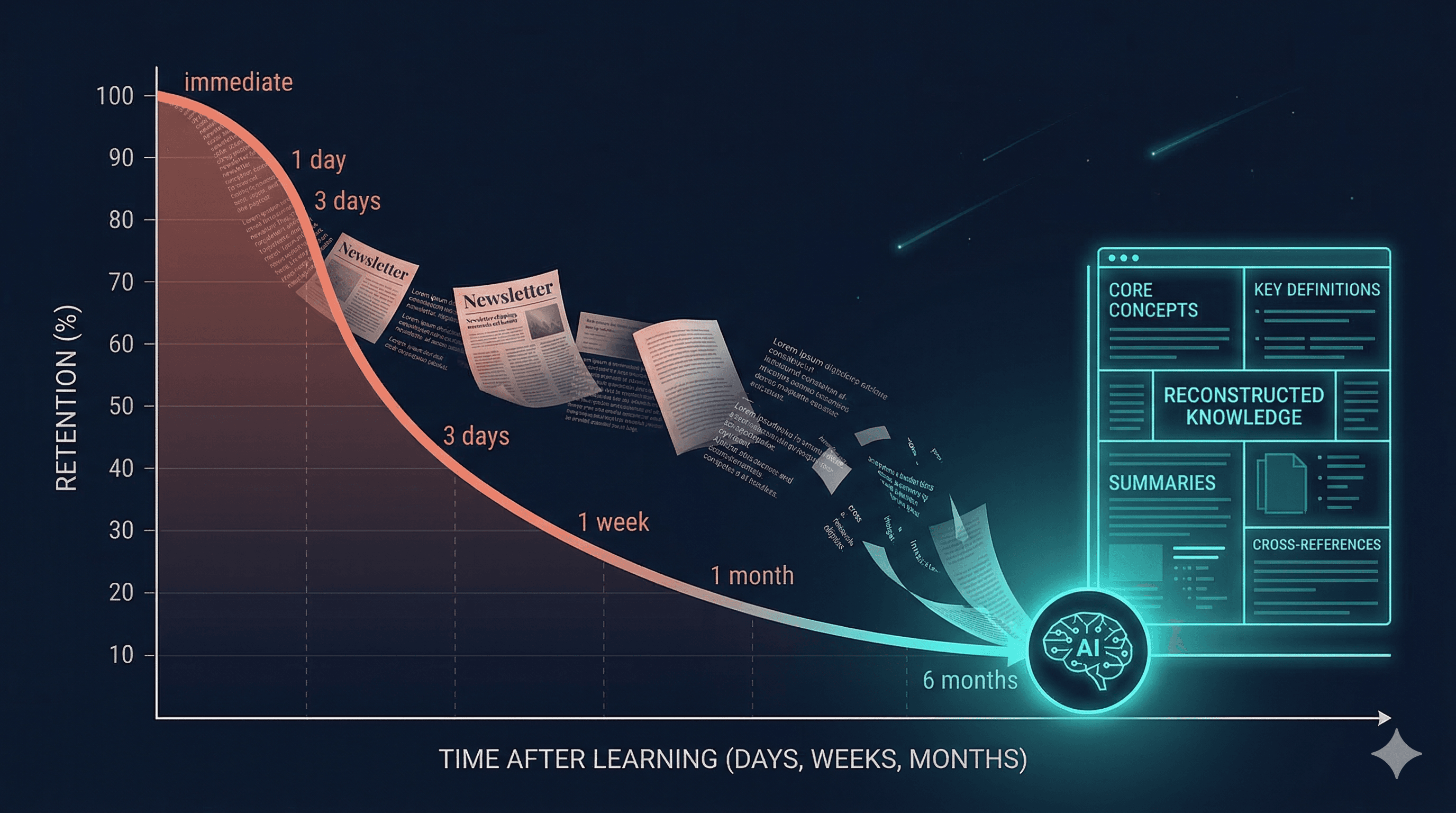
In 1885, a German psychologist named Hermann Ebbinghaus ran a bunch of experiments on himself and discovered what he called the "forgetting curve." The short version: within 24 hours of learning something new, you forget about 70% of it. Within a week, that number climbs to roughly 90%.
This isn't a bug. It's a feature. Your brain is constantly deciding what to keep and what to dump, based on how often you encounter the information and how emotionally significant it is. That pricing framework from last Tuesday's newsletter? Low emotional significance, encountered once, no reinforcement. Gone.
The survival logic makes sense. If you're a prehistoric human, remembering which berries are poisonous is more important than remembering the third point from a blog post. The problem is that we now live in a world where the third point from a blog post might actually be the thing that saves your business.
The information age made this exponentially worse.
We're consuming more information than any generation in history. Newsletters, podcasts, YouTube, Twitter, books, articles, Slack messages. The volume is insane. And our brains haven't evolved to handle it. We're running stone-age hardware with information-age input.
The result: you subscribe to 30 newsletters because the content is genuinely valuable. You read (or skim) maybe 10 of them. You retain useful information from maybe 2. The other 28 were a complete waste of the creator's effort and your subscription.
This is the core problem that drives me crazy. The knowledge is right there. You paid for it (with money or attention). And you can't access it when you need it.
The three traditional solutions (and why they don't work for most people).
Taking notes. The gold standard. Read the article, write down key takeaways, review them later. Works great for the 3% of humans with the discipline to do this consistently. For the rest of us, our note-taking attempts last about two weeks before we stop and never look at the notes again.
Spaced repetition. The science is solid: reviewing information at increasing intervals dramatically improves retention. Readwise does this with your highlights. It genuinely works. The problem is that it only works on content you've already highlighted, which means you still have to read and engage with the original material. It fixes the review problem, not the reading problem.
Building a second brain. Capture everything in Notion or Obsidian, tag it, link it, review it. Beautiful in theory. In practice, it's a second job. I've started and abandoned this approach three separate times. Each time, the setup was fun and the maintenance was unsustainable.
How AI actually fixes this.
The breakthrough isn't better note-taking or better review systems. It's eliminating the need for both by making the original content permanently accessible and queryable.
Here's what I mean: if you can search across every newsletter you've ever received and get an answer in 30 seconds, you don't need to remember the content. You just need to know it exists somewhere in your system. The retrieval happens on demand, not from your brain.
This is fundamentally different from every previous approach because it doesn't require you to do anything at the moment of consumption. You don't have to read more carefully. You don't have to take notes. You don't have to highlight. You subscribe to the content, it gets processed automatically, and it's there when you need it.
I built Adviserry around this exact principle. Your newsletters and YouTube subscriptions get ingested, summarized, and indexed without you lifting a finger. When you need to recall something, you search or chat with your boards. The forgetting curve becomes irrelevant because you're not relying on your memory anymore.
Other tools attack parts of this problem too. Readwise helps with review. Notebook LM helps with synthesis. Perplexity helps with real-time research. But the core shift is the same: stop trying to remember everything, and start building systems that remember for you.
The mindset change that matters:
For years I felt guilty about forgetting things I'd read. Like I was somehow failing at being a knowledge worker. Learning that the forgetting curve is universal (not a personal failing) was genuinely liberating. Your brain is working as designed. It's just not designed for the information environment we live in.
The fix isn't discipline. It's architecture. Build a system where the knowledge is always accessible, and your biological memory becomes a nice-to-have instead of the bottleneck.
You're not forgetting 90% of what you read because you're not trying hard enough. You're forgetting it because you're human. Build accordingly.